Guru Purnima: Why India's Youth Still Need a Guru
In an age of endless information, Guru Purnima reminds young Indians that wisdom, purpose, and sound judgement still come through the guidance of a trusted mentor.
The Narrative World 29-Jul-2026
Total Views |


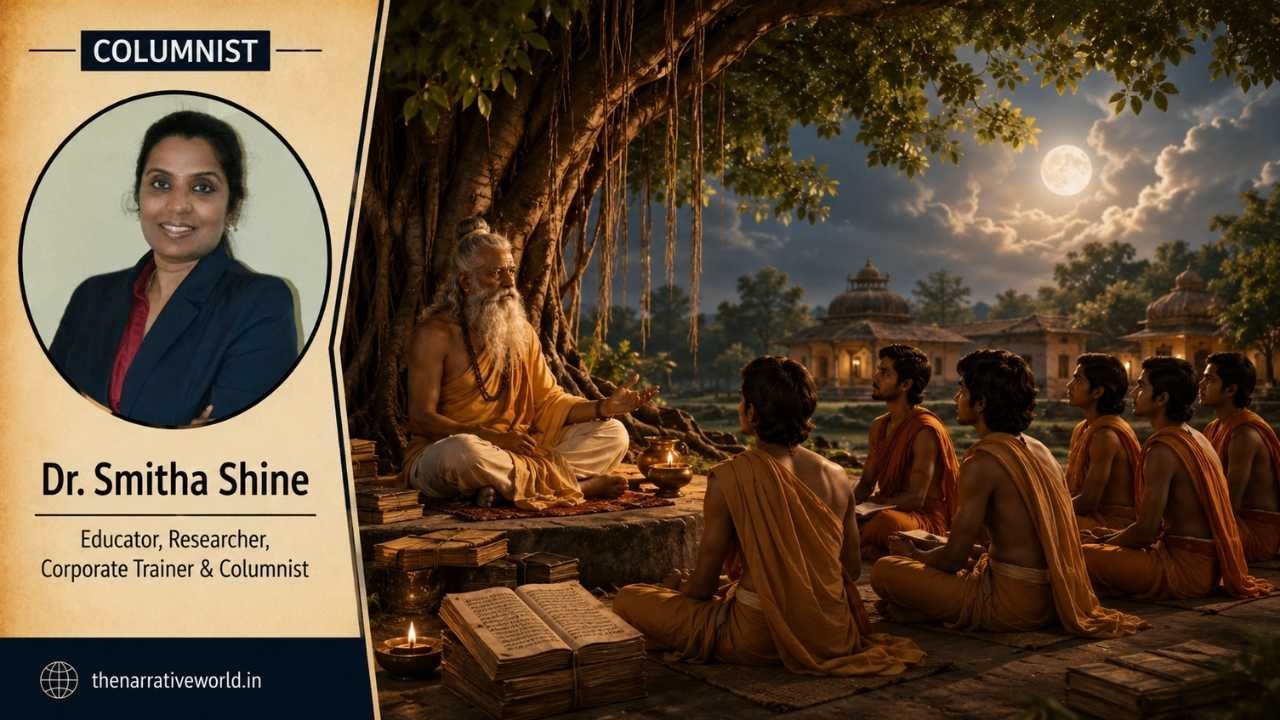
Every year, when the monsoon clouds gather and the moon is full, India remembers something the modern world often forgets: no one succeeds alone. Guru Purnima falls this year on July 29. It is not just an old custom. It asks every generation a profound question: who is guiding you, and where are they guiding you?
I have taught for many years. I have watched young people arrive intelligent, worried, and often alone. They have more information than any generation before them, yet they often have fewer people to help them make sense of it. A search engine can answer a question in seconds, but it cannot tell a student when they are asking the wrong question. It cannot tell them when their ambition has quietly turned into anxiety. That is a guru's role. Nothing can replace it.
The word guru means "one who removes darkness". Gu means darkness, and ru means the one who removes it. This darkness was never simply about not knowing facts. It was confusion about purpose, not knowing what you are here to do. Guru Purnima honours Vyasa, who compiled the Vedas and wrote the Mahabharata. He did not merely pass on knowledge. He transformed chaos into wisdom that an entire civilisation could live by. That is very different from passing an examination or a competitive test. Our young people deserve to understand this distinction.
I worry that today's youth are taught to optimise before they are taught to find direction. We carefully measure rank, percentile, and salary, but we almost never ask a student what kind of person they are becoming. A guru's true role was never to make a student dependent. It was to help them become capable of thinking clearly and independently, what Indian tradition calls viveka. This ability cannot be downloaded. It is built gradually. It grows through correction and through hearing uncomfortable truths from someone who has earned the right to say them because they genuinely want what is best for you.
So here is my message to young readers this Guru Purnima. First, look for a guru deliberately. This does not have to be a formal teacher. It can be anyone whose judgement you trust enough to allow them to correct you: a parent, a professor, a coach, or an experienced elder in your field. Do not fall for the idea that curated feeds and algorithms can replace this kind of relationship. They are designed to hold your attention, not to help you grow.
Second, once you find such a person, give them something rare in this distracted age: your full and genuine attention. Guru Dakshina, the gift traditionally offered to a teacher, was never really about the gift itself. It was about practising gratitude, which keeps ambition from turning into arrogance.
India did not become a civilisation renowned for great ideas simply by producing brilliant individuals. It achieved that through unbroken chains of teaching and learning, where each generation guided, corrected, and uplifted the next. That chain will continue only if today's youth consciously choose to become good students before they become leaders. This Guru Purnima, that is the inheritance worth claiming.
Written by

Dr. Smitha Shine
Educator, Researcher, Corporate Trainer & Columnist

नैरेटिव डेस्क
नैरेटिव डेस्क