When the Leak Becomes "Just Cheating": AAP’s Denial, Congress’s Amnesia, and the Politics of Selective Outrage
How AAP shields its ministers with semantics while Congress demands resignations it never offered during its own paper-leak years.
The Narrative World 29-Jul-2026
Total Views |


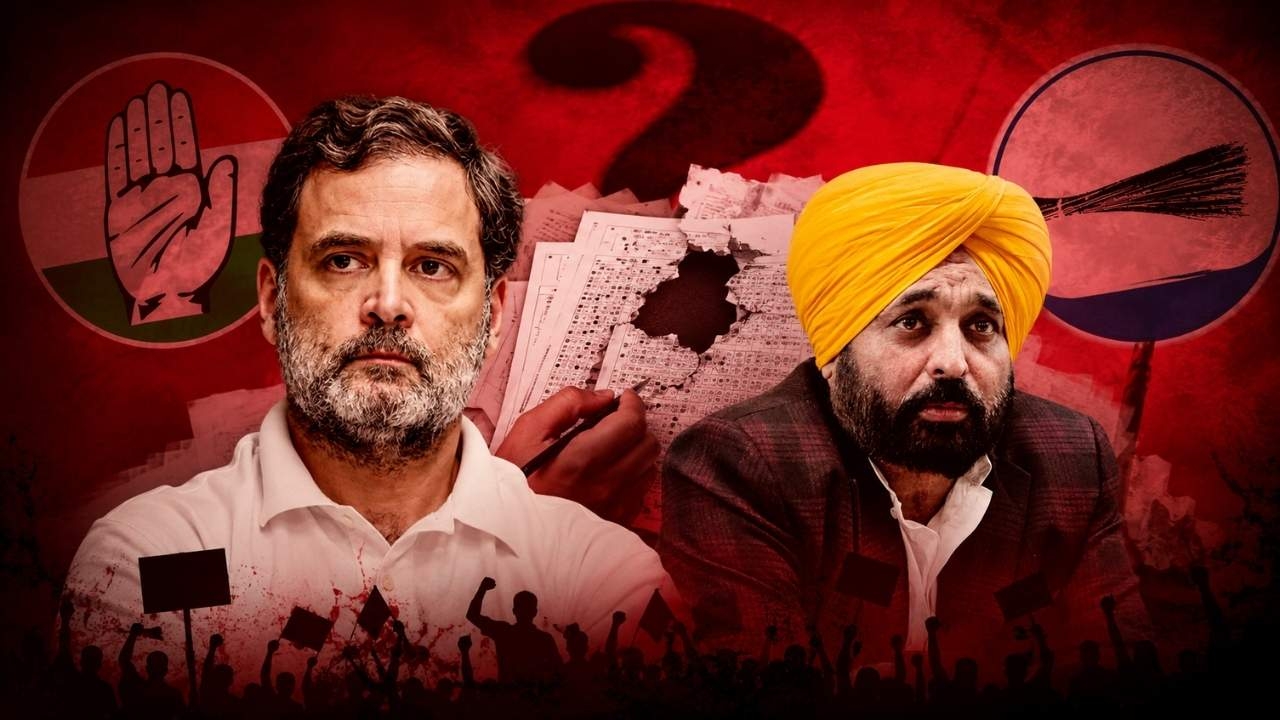
Paper leaks and examination malpractices have long plagued India's competitive and board examinations, affecting crores of aspirants across party lines.
Students, Maoism-leaning activists, Islamic activists, and AAP workers camped at the historic protest site, demanding accountability, transparency, and the resignation of those responsible for safeguarding the future of millions of aspirants. This entire series of events culminated in Dharmendra Pradhan's exit, which was widely projected by the opposition as a "political victory".
Yet the very same parties celebrating this resignation have displayed a strikingly different approach when similar controversies have emerged under their own governments.
Let us take a closer look at the pattern they have been operating under for years.
AAP Government in Punjab: Alleged Controversies and the Absence of Accountability
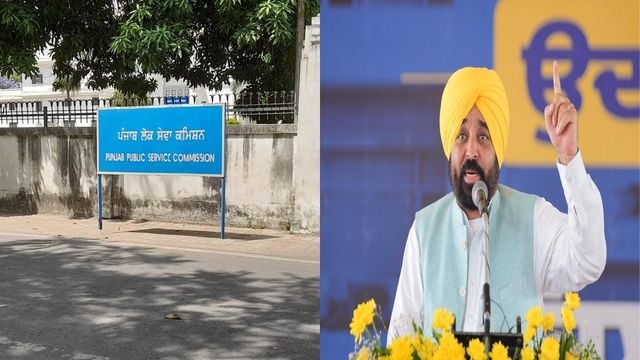
AAP assumed power in Punjab in March 2022. Chief Minister Bhagwant Mann and senior party leaders, including Manish Sisodia, have repeatedly claimed that "not a single paper has leaked" during their four-and-a-half years in office, insisting that government jobs, which they claim number over 68,000, have been awarded purely on merit.
However, these claims appear increasingly difficult to reconcile with a series of reported controversies.
May 2022: Punjab Public Service Commission (PPSC) Naib Tehsildar examination cancelled, affecting around 42,000 candidates.
February 2023: Punjab School Education Board (PSEB) Class 12 English paper allegedly leaked minutes before the examination began.
March 2023: Punjab State Teachers Eligibility Test (PSTET) Paper II cancelled after correct answers for at least 50 questions appeared highlighted in bold in the question paper.
June 2024: Allegations of paper leak and bribery surfaced in the Agriculture Development Officers (ADO) recruitment examination, including complaints that a senior official accepted large sums of money.
December 2025: Irregularities and alleged tampering were reported in the Punjab Subordinate Services Selection Board (PSSSB) Group B examination.
19 July 2026: The Pharmacy Officer recruitment examination for 454 posts, conducted by Baba Farid University of Health Sciences, allegedly involved a sophisticated inter-state racket. According to reports, pen cameras were used to photograph the question paper inside examination centres. The images were transmitted via WhatsApp to handlers, including individuals based in Haryana, who dictated answers in real time through Bluetooth earpieces and concealed electronic devices. Candidates reportedly paid between ₹3.5 lakh and ₹13 lakh for the service.
Notably, senior AAP leader Manish Sisodia had earlier stated, around the time of the nationwide protests, that if a paper leak occurred in Punjab, the state's education minister would be dismissed immediately. He also claimed that Punjab had maintained a clean record. However, no such accountability has been demonstrated by the Punjab government, despite the assurance Sisodia had publicly given.
Paper Leaks Under Congress and UPA Governments: Centre and States
Paper leaks are a systemic and long-standing problem driven by weak security protocols, insider complicity, coaching-centre networks, and low conviction rates. Analyses of major documented cases, including those that resulted in cancellations, re-examinations, FIRs, or official investigations, indicate that such incidents occurred under multiple political parties.
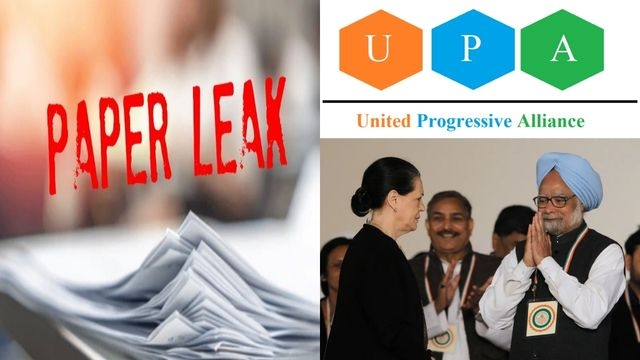
One review of 110 cases between 2004 and 2026 attributed approximately 24 to the years of UPA rule at the Centre. Another large-scale analysis covering examinations involving more than one lakh candidates identified 14 major cases under Congress-led state governments.
Examples from the UPA period between 2004 and 2014 include:
2004: All India Pre-Medical Test (AIPMT/CBSE-PMT) papers leaked hours before the examination in Delhi, resulting in nationwide cancellation, a CBI investigation, and multiple arrests.
2006: CBSE Class 12 Accountancy paper leak in Congress-ruled Delhi.
2007: All India Engineering Entrance Examination (AIEEE) paper leak reported across multiple states.
2008: Pre-Medical Test (PMT) paper leak incidents and Railway Recruitment Board (RRB) examinations involving the sale of question papers, leading to large-scale cancellations and arrests.
2011: AIEEE paper leak in Uttar Pradesh, resulting in delays and re-examinations affecting tens of thousands of candidates, alongside other board and recruitment-related irregularities.
2012: AIIMS postgraduate entrance examination paper leak involving the use of mobile phones and Bluetooth devices, resulting in multiple arrests.
2014: During the final phase of UPA rule, issues relating to CBSE Class 10 and Class 12 examination papers were reported.
State-level cases under Congress or allied governments add further examples.
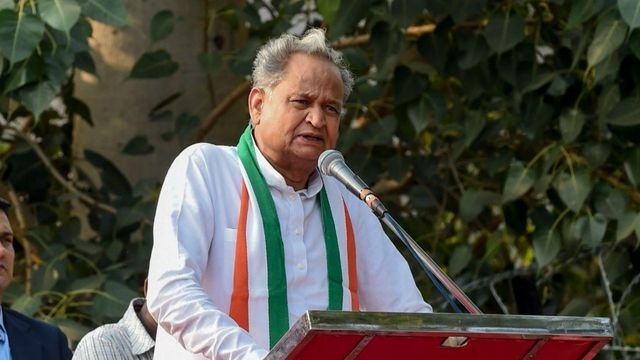
In Rajasthan, under Ashok Gehlot's Congress government, particularly between 2018 and 2023, multiple recruitment and eligibility examinations faced paper leaks or other irregularities. These included the high-profile REET (Rajasthan Eligibility Examination for Teachers) 2021, Sub-Inspector recruitment, Senior Teacher Grade II, Junior Engineer recruitment, and several other examinations. Reports suggested an average of several paper leaks each year during this period, cumulatively affecting lakhs of aspirants. Investigations resulted in numerous arrests, including, in certain instances, that of a Rajasthan Public Service Commission (RPSC) member. Several examinations were cancelled, and the state eventually enacted a stringent anti-paper leak law.
Similar patterns were reported in other Congress-ruled or UPA-allied states over the years, including Himachal Pradesh, Karnataka during the pre-2013 transition period, Chhattisgarh, and others featured in historical compilations of examination irregularities.
Parliament Stalemate Over Tougher Anti-Paper Leak Law
Efforts to strengthen India's legal framework against paper leaks also encountered significant political resistance in Parliament.
The Public Examinations (Prevention of Unfair Means) Act, 2024, was originally passed with bipartisan support in February 2024. However, when the Modi government introduced amendments in July 2026 to significantly strengthen the law by increasing the maximum term of imprisonment, substantially raising financial penalties, mandating time-bound investigations within two months, and establishing special fast-track courts, opposition MPs launched sustained protests inside Parliament.
Demanding statements on the police action during the CJP-led student march, along with broader discussions on alleged NEET irregularities, opposition members resorted to slogan-shouting and continuous disruptions. As a result, the Lok Sabha was adjourned repeatedly. Although the amendment Bill was formally introduced, the House could not proceed with debate or passage.
Consequently, the government's attempt to strengthen the legal framework against organised paper leaks and examination fraud was effectively stalled by the opposition's refusal to allow orderly parliamentary proceedings.
Written by

Kewali Kabir Jain
Journalism Student, Makhanlal Chaturvedi National University of Journalism and Communication
नैरेटिव डेस्क
नैरेटिव डेस्क