Indian Army Gets a Precision Boost with Pinaka LRGR
DRDO successfully validated the Pinaka LRGR at a minimum range of 60 km, strengthening the Indian Army’s precision strike capability using existing launchers.
The Narrative World 09-Jul-2026
Total Views |


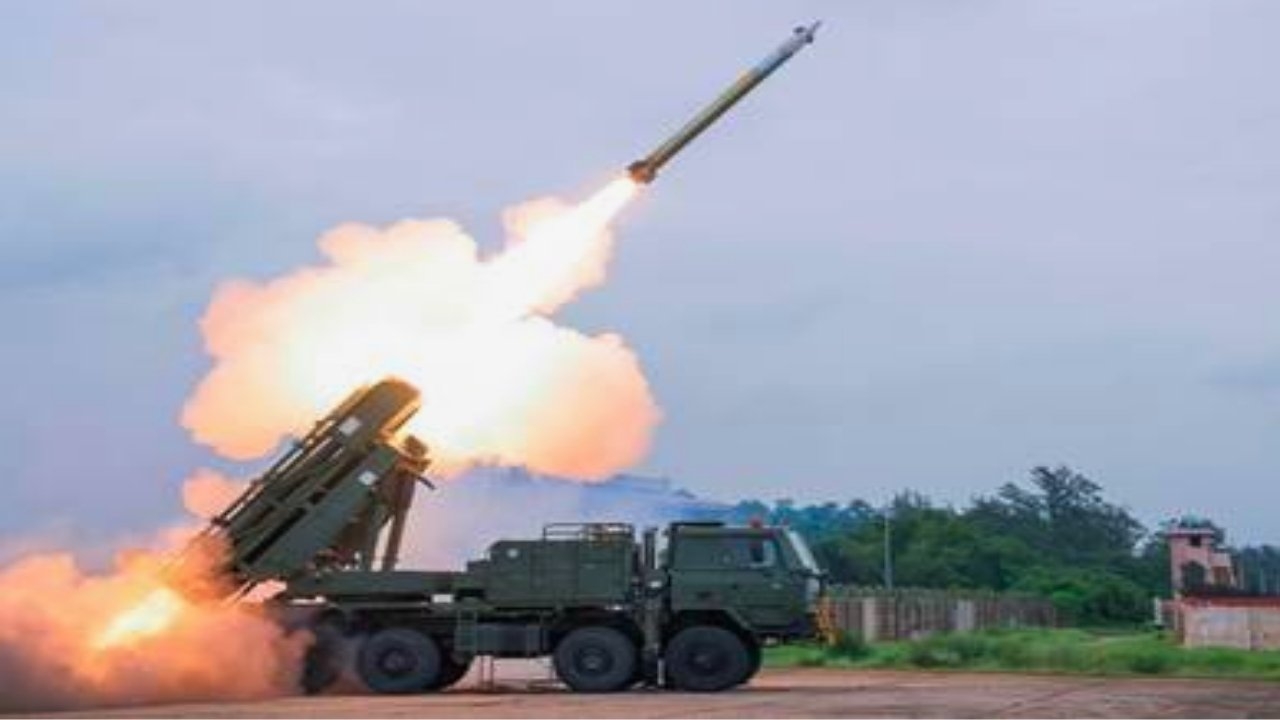
In yet another demonstration of Bharat’s growing prowess in indigenous defence technologies, the Defence Research and Development Organisation (DRDO) successfully flight-tested the Pinaka Long Range Guided Rocket (LRGR) on 8 July 2026 at the Integrated Test Range (ITR), Chandipur, Odisha. The test validated the rocket’s performance at a user-defined minimum range of 60 kilometres, with the missile executing all planned in-flight manoeuvres and impacting the target with textbook precision exactly along the predicted trajectory. All deployed range instruments tracked the flight flawlessly from launch to impact.
The successful trial, conducted from an in-service Pinaka Multi-Barrel Rocket Launcher (MBRL), underscores a key operational advantage: the same launcher platform can now seamlessly fire different Pinaka variants across a wide spectrum of ranges. This versatility significantly enhances the Indian Army’s logistical flexibility and battlefield responsiveness.
The Evolution of Pinaka: From Kargil Warrior to Precision Long-Range Striker
The Pinaka system, named after the divine bow of Lord Shiva, has come a long way since its baptism by fire during the 1999 Kargil War. The original unguided Mk-I variant, with a range of around 37.5 to 40 km, proved highly effective in neutralising Pakistani positions on high-altitude mountain terrain where conventional artillery struggled.
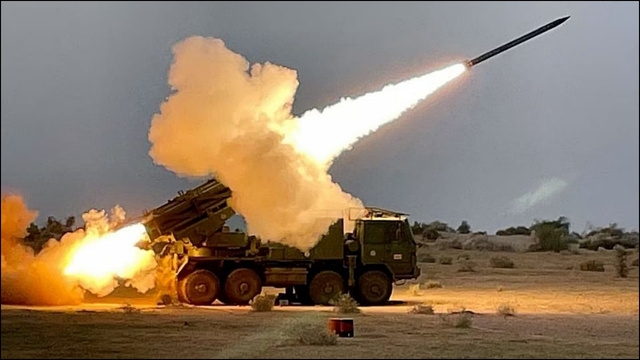
Over the past two decades, relentless indigenous development by DRDO laboratories, primarily the Armament Research & Development Establishment (ARDE) in Pune, in close association with the High Energy Materials Research Laboratory (HEMRL) for propulsion, and supported by the Defence Research & Development Laboratory (DRDL) and Research Centre Imarat (RCI) for guidance, has transformed Pinaka into a modern, modular family of rockets.
Key variants now include:
- Enhanced and Mk-II versions reaching 45 to 60 km.
- Guided Pinaka with ranges of more than 75 km and dramatically improved accuracy.
- Extended-range (Mk-II ER) versions reaching up to 90 km.
- The current LRGR (Long Range Guided Rocket) class, capable of engaging targets up to 120 km with high precision.
The 8 July test specifically validated the minimum range envelope of 60 km as per Army requirements, while confirming the system’s full performance potential in the longer-range guided configuration.
Unlike earlier free-flight rockets, the LRGR incorporates an advanced guidance suite, typically comprising a Ring Laser Gyro or MEMS-based Inertial Navigation System (INS) integrated with multi-GNSS, including Bharat’s NavIC and GPS, often with mid-course updates and terminal correction. This has reduced the Circular Error Probable (CEP) to single-digit metres in guided variants, as low as 2 to 3 metres demonstrated in earlier trials, representing a massive improvement over unguided rockets.
The result is a cost-effective, high-volume precision strike weapon capable of neutralising high-value targets such as enemy artillery concentrations, command nodes, logistics hubs, and fortified positions deep behind the Forward Edge of the Battle Area (FEBA), while significantly reducing collateral damage and ammunition expenditure compared with unguided salvos.
Strategic and Operational Significance
The LRGR’s successful integration with existing Pinaka launchers, mounted on robust Tatra 8x8 or similar high-mobility trucks, is particularly noteworthy. The Indian Army has been steadily raising additional Pinaka regiments as part of its artillery modernisation drive, especially after the 2020 Galwan standoff. The ability to field mixed-range salvos from the same launcher reduces the logistics burden and increases operational tempo, a critical factor in high-intensity conflict scenarios along Bharat’s northern and western borders.
In modern warfare, where long-range precision fires are increasingly decisive, systems like the Pinaka LRGR provide the Indian Army with a potent, mobile, and survivable deep-strike option that complements cruise missiles, such as BrahMos, and other stand-off weapons without the same cost or infrastructure overhead.
Atmanirbhar Bharat in Action
From design and propulsion to guidance and launcher integration, the entire manufacturing ecosystem is indigenous. Production partners from both the private and public sectors are already scaling up manufacturing, ensuring that the armed forces receive reliable, battle-ready systems without dependence on foreign suppliers.
The name itself, Pinaka, carries deep cultural resonance, symbolising strength, precision, and divine sanction in the Indian civilisational consciousness. It is fitting that a weapon system bearing this name is now evolving into one of the pillars of Bharat’s conventional deterrence.
Written by

Kewali Kabir Jain
Journalism Student, Makhanlal Chaturvedi National University of Journalism and Communication

नैरेटिव डेस्क
नैरेटिव डेस्क