Bangladesh: Fresh Wave of Targeted Violence Once Again Claims Lives of Hindus
With six Hindus killed in just 18 days, recent murders underline rising insecurity for Hindu minorities in Bangladesh.
Total Views |


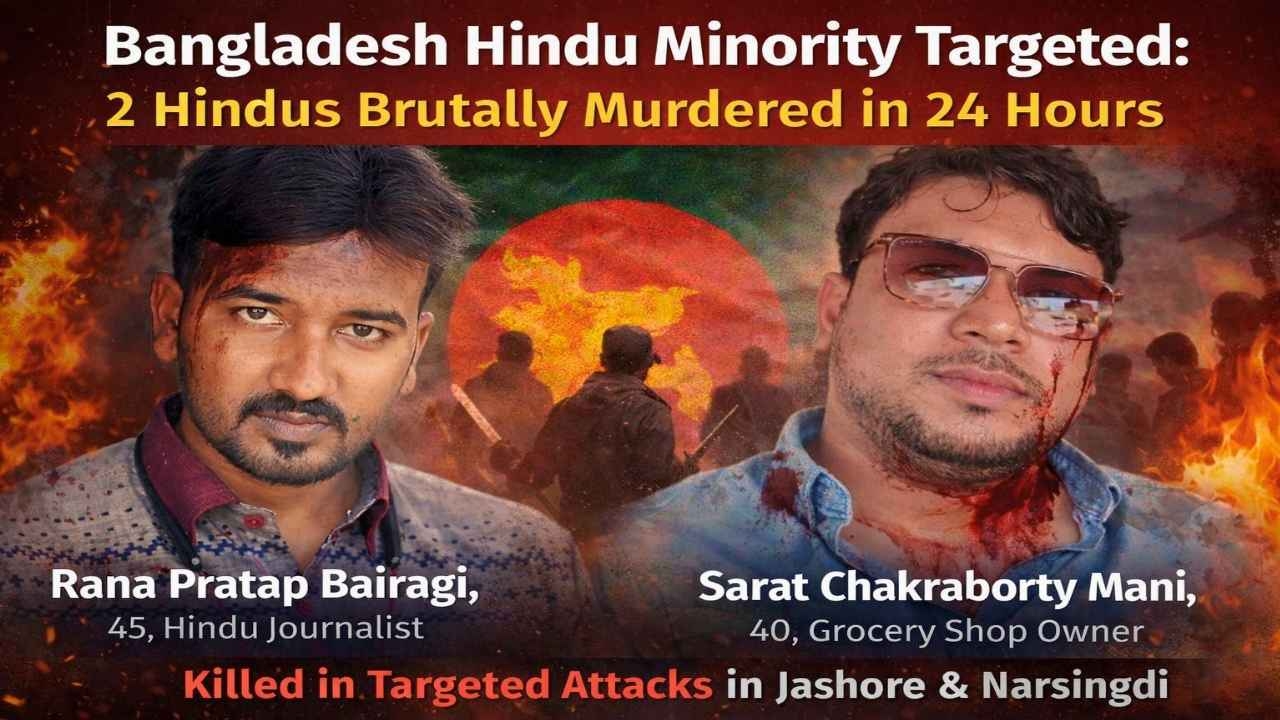
Bangladesh has witnessed a renewed spike in targeted violence against its Hindu minority, with two killings reported within 24 hours. The incidents have intensified concerns over the country’s deteriorating law-and-order situation and the safety of religious minorities. With these latest murders, the number of Hindus killed in targeted attacks over the past 18 days has risen to six.
The most recent victims have been identified as Sarat Chakraborty Mani, a 40-year-old grocery shop owner from Narsingdi district, and Rana Pratap Bairagi, a 45-year-old Hindu journalist and acting editor of BD Khobor, who was murdered in Jashore.
Grocery Shop Owner Hacked to Death in Narsingdi
Sarat Chakraborty Mani was attacked on Monday night at Charsindur Bazaar in Palash Upazila of Narsingdi district, where he was running his grocery shop. According to Bangladesh-based news channel Blitz, eyewitnesses said unidentified assailants suddenly attacked him with sharp weapons, leaving him critically injured. He died while being taken to hospital.
Mani was the son of Madan Thakur, a resident of Sadharchar Union in Shibpur Upazila. He is survived by his wife, Antara Mukherjee, a homemaker, and their 12-year-old son, Abhik Chakraborty. Mani had previously worked in South Korea and returned to Bangladesh a few years ago. He later settled in Brahmandi, Narsingdi town, where he lived with his family.
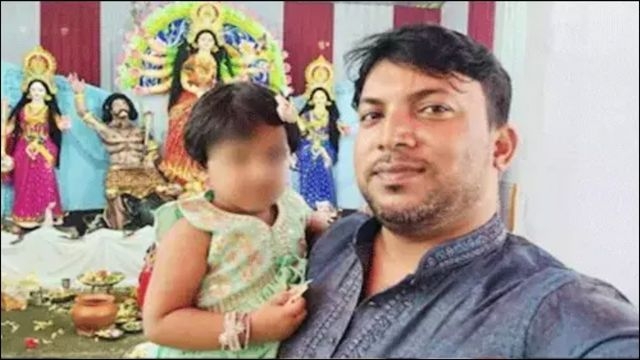
A family member, speaking on condition of anonymity, said Mani led a quiet and peaceful life and had no known disputes with anyone. However, the family said he was deeply troubled by the worsening situation in the country. In a Facebook post dated December 19, Mani wrote: "So much fire everywhere, so much violence. My birthplace has turned into a valley of death."
Neighbours described him as calm, humane and socially responsible, stating that he had no enemies. According to them, his Hindu identity appeared to be the only possible motive behind the killing.
Hindu Journalist Brutally Murdered in Jashore
On the same day, Rana Pratap Bairagi, also known as Rana Pratap, was brutally murdered in Manirampur in Jashore district. The 45-year-old factory owner and acting editor of BD Khobor was shot multiple times in the head and had his throat slit at Kopalia Bazar.
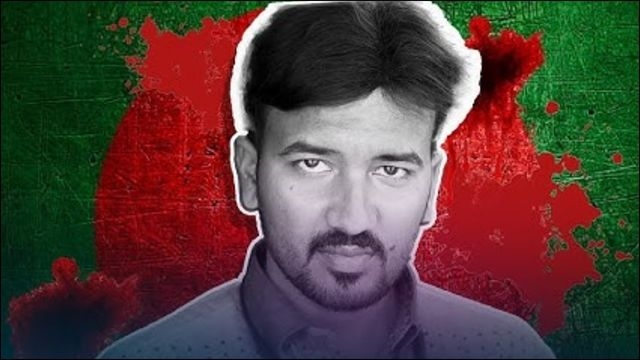
Monirampur Police Station officer-in-charge Md Raziullah Khan said the attack took place around 6 pm. "Rana was shot three times in the head and his throat was slit. The body has been recovered and sent for autopsy. We are investigating the perpetrators," he said. Police recovered seven bullet casings from the crime scene.
An eyewitness, Ripon Hossain, said the attackers arrived on a motorcycle, called Rana out of his ice factory, shot him repeatedly and fled immediately. Rana was the son of a schoolteacher from Arua village in Keshabpur Upazila and had been running his ice factory for the past two years.
Pattern of Violence Against Hindus
These murders form part of a broader and deeply alarming pattern of violence against Hindus across Bangladesh in recent weeks. In Mymensingh district, Dipu Chandra Das, a garment factory worker, was lynched by a mob last month. His body was later hung from a tree and set on fire. Last week, Khokon Das, a 50-year-old Hindu pharmacy owner and bKash mobile banking agent, was attacked while returning home from Keherbhanga Bazaar and later died from his injuries. Another Hindu garment worker, Bajendra Biswas, was shot dead while on duty at a factory in Mymensingh.
Alongside these killings, cases of sexual violence against Hindu women have sparked widespread outrage. In Jhenaidah district, a 40-year-old Hindu widow was tortured, raped, tied to a tree and had her hair forcibly cut. She was rescued in an unconscious state and admitted to Jhenaidah Sadar Hospital. Hospital superintendent Dr Mohammad Mustafizur Rahman confirmed that medical examinations indicated severe physical torture. Police have arrested two accused in the case.
Post-2024 Political Fallout
The current wave of violence cannot be viewed in isolation. Bangladesh has a long history of persecution of Hindus, rooted in decades of political instability, Islamist radicalisation and systematic marginalisation of minorities. From the communal violence following Partition to repeated pogroms after elections and regime changes, Hindus have frequently borne the brunt of political upheaval.
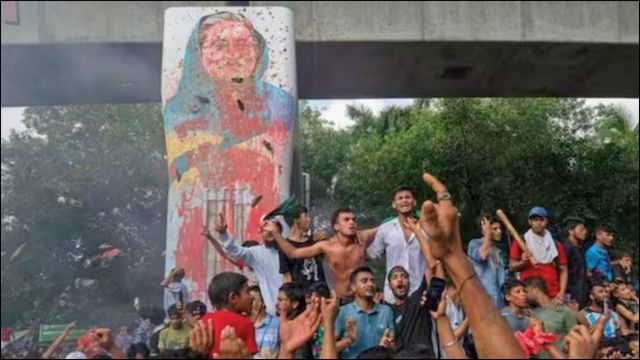
The situation has worsened significantly following the 2024 political coup, which many observers have described as a "murder of democracy". The overthrow of an elected government and the installation of an interim administration led by Muhammad Yunus created a power vacuum. This weakened state institutions, brought the military onto the streets and emboldened radical and criminal elements.
The Hindu Buddhist Christian Unity Council of Bangladesh claims that between August 2024 and June 2025, at least 2,442 incidents of violence against minorities took place. These included killings, sexual assaults and attacks on places of worship. Separate reporting by Prothom Alo documented that more than 1,000 houses and business establishments owned by religious minorities were attacked in the first two weeks after Sheikh Hasina’s government was ousted in August 2024.
The repeated incidents of violence, coupled with the absence of consistent legal action, suggest that Bangladesh is experiencing what sociologists describe as "norm erosion". This refers to a situation in which laws continue to exist on paper but no longer influence behaviour in practice. In other words, rules remain formally in place but are not enforced in a manner that deters violence or maintains order.
Taken together, reports of targeted killings, mob violence, intimidation, land grabs and assaults against Hindus indicate a clear pattern rather than isolated criminal acts. Hindus, critics argue, are being systematically terrorised and eliminated solely because of their religious identity.
Article by
Kewali Kabir Jain
Journalism Student, Makhanlal Chaturvedi National University of Journalism and Communication