1956: Report of the Christian missionary activities enquiry committee (Part - 7)
The 1956 inquiry examined foreign funding and accounts of conversion efforts through schools, hospitals, orphanages and financial assistance in Madhya Pradesh.
Total Views |


The 1956 Christian Missionary Activities Enquiry Committee examined missionary work in Madhya Pradesh after Independence, documenting foreign funding and accounts of conversion efforts through schools, hospitals, orphanages and financial aid, alongside disputes over religious instruction.
We had many bitter memories of partition on the basis of religion, the arrival of Western Christian Missionaries and their activities during British rule. Hardly the examples of their support to the independence movement, ultimately a democratic and a secular state was set up in the land which was overwhelmingly Hindu with small minorities.
In spite of this, the report states that the attitude of minorities had not been helpful, ‘backdoor sabotage’ might have been tried but the country expected harmony. The claim of separate electorate in some provinces, was withdrawn by Indian Christians.
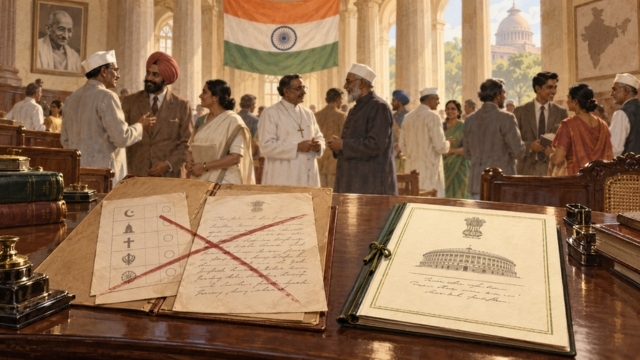
Within the short period after the independence, it was claimed that Christian missionaries were harassed and were not allowed to propagate their religion. So the evidence was collected by the committee on this issue.
The first point is about the foreign funds. Missionaries in India received foreign assistance by a number of missions.
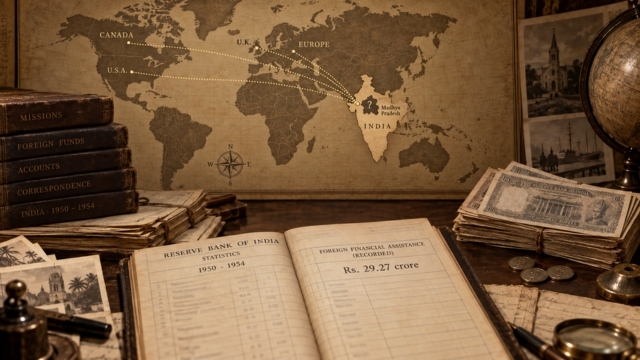
Within 4 years (1950-1954) a huge amount of money (29.27 crores) was received by our country. It came from countries like the US, Canada, Belgium, Denmark, France, Germany, Norway, Sweden, Switzerland and some other countries. The statistics were maintained by the Reserve Bank of India, though the amount used in Madhya Pradesh could not be ascertained precisely.
It is recorded that Rev. Lakra received 1.5 lakh from US to be used for the activities in 5 provinces in 1953-54. The report documents one example of a high school from Chhindwara, which needed Rs 33,000 for a year, out of which only Rs. 9,613 were received from church and the rest was given by the Government as a grant and subsidy. Similarly Leper Asylum received Rs 33,000 from a Mission and Rs 39,000 were given as grants by the government besides agricultural income. Many such examples are documented in the report. Schools received the donations for the buildings, running the educational institutions, to meet the deficit (some deficit was due to the activities of churches), and hospital expenses too.
All this has been documented by the report. The report mentions the example of Surguja where a big number of preachers were appointed for conversion. Quite a significant number of conversions took place in some assemblies. The number of new converts at some places was as big as 1200. Even there was a sort competition among the churches. It is also reported that the advantage of financial assistance too worked to a great extent in converting people. It was offered by the West on the basis of ‘Partnership in Obedience’. This was offered to help ‘in extending the Kingdom of God’. This is described as ‘a veritable invasion’ supported by finance.
The strategy is in a way associated with the ‘cold war’ too, it in a way conversion was viewed as a deterrent against infiltration of Communists. Foreign money definitely had an influential role in our country. (reference Raja Ram Mohan Roy, who protested against exploitation by missionaries, from a book by Parekh)
Foreign funding was even described as an addition to the wealth of the country which helped in feeding the hungry and healing. A missionary mentioned that out of Rs 1,12,500 of the institution he was working for, only 6,000 was from the Indian sources. The rest came from the mission board abroad. ‘The strings of the purse were in the hands of the foreign Missionaries’. The words that described the position best. The headquarters were set up in India, but foreign missionaries were the part of the managing bodies.
The number of teachers cum pracharaks was big and all were paid Rs 40 per month. (the cost of gold was around Rs 80 in 1956 and today it is more than 1.5 lakh). There is a mention of one at Bilaspur being paid Rs 82 per month. Some were paid Rs 60 or 90 per month too. These teachers were appointed in many districts. Thus with this the conversion was carried out amongst the backward tribes, the report noted.
It was difficult to find out how much the foreign missionaries paid, but one missionary stated that he was paid 63 dollars per month (approximately 300 rupees in 1956) besides free quarters and vehicle allowance. They were offered well furnished bunglows, vehicles and some other facilities. It is also noticed that local missionaries observed the difference and were certainly not happy with it.
It is observed that paid professional missionaries, Indian or foreigners, were a reality. Thus the major share of funds went into paying these missionaries. By 1955 there were 4,877 such missionaries working.
It is noted that 480 foreign missionaries were working in the missions in Madhya Pradesh by 1954. They belonged to Europe and the US. There were many others who were not attached to a particular church.
Schools were used as a means in conversion, but it is noted that educating children was not the mandate, conversion was the main activity. With the self- government, it was stated that it would not be possible to help conversion easily.
It is clearly asserted that medical and educational institutions were tools to strengthen conversion. They were described as the ‘means of expansion of the Kingdom.’ Schools were supposed to produce devout Christians. Thus, young students were being targeted specially. All this was going on in the name of God.
Some missionary schools offered children free boarding, lodging and books, and invited them to attend Christian prayers. It also records cases in which boys’ names were changed after admission, with the new names appearing on their primary school certificates despite their families identifying as Hindu. The report says these schools admitted many children from lower-caste communities, particularly the Balahi community, and names the schools and individuals involved. Some families objected to the name changes. Thakkar Bapa drew attention to these practices.
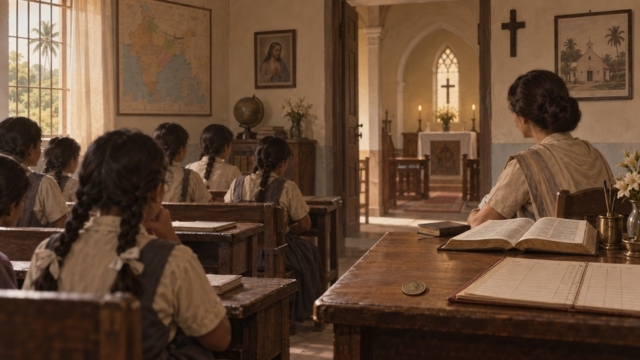
Despite the Conscience Clause Christian mission schools taught Bible to children, attendance was marked, it was in a way compulsory to attend the Christian prayers in the girls school too,even their knowledge was tested. It was mandatory for the Resident students to attend Sunday prayers in the Church. Absent students were fined one anna for not attending.
The report described a drama staged on 15th August 1954 when along with the national flag the flags of America, England and Pakistan were brought and at the end the flag with a cross was hoisted at the top. This was, the school said, to promote friendship among the nations.
Non Christians students attended the prayers to get help in the study and promote the welfare of the country.
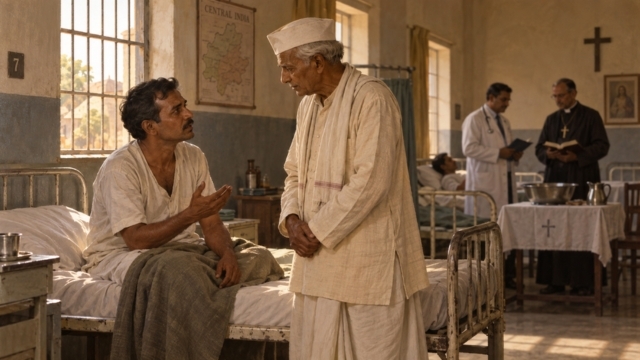
The stories of the hospital too describe the similar trends. The prayers were offered every day and patients were influenced to embrace Christianity. There is also an incident of the demand of Rs 35 for the treatment or to give away the child for being brought as a Christian. Many such complaints were received by the commission. There were cases of reverting to Hinduism voluntarily after 21 years once the government took over the management of a Leper Asylum. Around 100 patients reverted but some remained Christians.
It was always emphasised publicly that sickness was cured by the Faith in Christ. It was said that praying to Christ saves life, our simple people believed it to a great extent. Prayers were the means to bring people to Christian fold.
Indian Gods were portrayed as bad characters and were severely criticised. They were described as stone Gods or dead Gods, some Gods were labeled as adulterous. Jesus was described as the one who died for the wicked on the other hand Rama killed Ravana, even Krishna killed his enemy and thus all Gods were ridiculed too.
A copy of the book obtained by the commission stated that the entire country ought to be christianised. ( Bharat Alele Preshit ) There are also instances of apology when prosecuted.
A report on the 50th jubilee ( 1898 - 1947 ) of the Leper Asylum printed on the last page that 2,552 were Christians ( converted ) who were noninfectious.
One more leper Asylum is reported to have converted 154 persons between 1947 to 1954, and the government contributed Rs 26,000 every year towards the treatment. Though this objective was never publicly admitted.
Church personnel supported the baptisms, while hospital inpatients faced pressure to convert. Mahant Nayandas, an MLA and secretary of the Akhil Bharatiya Sanatani Sabha in Raipur, described a case in which a convert sought to return to Hinduism (ghar-wapsi). He said he had witnessed these practices while admitted to the hospital himself. According to his account, the doctor was expected to take part in the conversion process.
Christian orphanages were also examples of converting people. Due to natural calamities like famine, floods or earthquakes, many children took Asylum in orphanages. This was used to convert them at such a young and vulnerable time. The number was mostly from the backward classes.
Money lending too was used as an effective tool for conversion. The loan was granted in the guise of helping but on the condition of chopping off the top-knot ( choti ) and obviously conversion or else the loan was to be repaid with the interest. The poorest class was reached by missionaries, unfortunately the places where government help could not reach. The money was not to be repaid on conversion. Obviously this was never admitted openly, but loan and help in litigation were always the means to conversion.
Many such examples are cited with the names in the report. Though restrictions were imposed by the authority ( under British rule too ) it could not deter them. As it is already stated the focus was on the lower casts. Even the government officials were asked to help, but villagers mostly did not like attending the prayers, this always invited the displeasure of the church.
Christian government officials were also expected to help the church in their mission. Wherever Christian teachers or principals worked they too tried to propagate the religion.
The bhajans styling them as “Yeshu bhajans” too were recited. Even the words of bhajans were changed to sound like their style. No stones were left unturned.
Except christianity all the other religions were referred to as false religions and worship of Satan. Children were advised not to go to government schools as they taught false religion. The country was ridiculed as it depended on America for financial aid and supply of wheat.
Our religions were described as which could never bring peace, the reason given was rejecting Christ. The attacks on Hinduism were absolutely ‘virulent and sinister, (many examples are noted in the report). Hinduism was illustrated as ‘the most material and childishly superstitious animalism’. Of course this was ignored by missionary authorities as the mistaken zeal of some fanatics. All this had the documentary evidence which was gathered by the commission.
Tribals and Harijans were mainly the targets and were viewed as the most exploitable. This caused some resentment against the missionaries too. This certainly disturbed the public order. Thus, it is clear that the conversion was never in its real sense based on deep thought, most of the converts were not aware of the new religious beliefs, even the newly appointed Pracharaks of Christianity were equally ignorant.
When the list of converts within the 2 years was presented to the commission it had the people ranging from 1 to 60 years of age. It observed the absence of religious feeling too, thus they were nominal Christians. Many did not want to convert but they did so under some obligation. Later stopped practicing Christianity and returned to the old faith after some time. (1931). As mentioned earlier there were financial or political reasons for conversion, but the records of Baptism were well preserved. The commission was presented with all the records. Of course some implicit methods too were used to allure for the conversion. This probably can explain the Gharvapasi. Many missionaries admitted the fact too. Illiteracy of the people was mostly the reason for mass conversion.
Conversion is always treated as Denationalisation or a subversive trend. Gandhi ji stated this in his book ‘Heritage of Indian Christian’. The commission could lay its hand on some evidence.
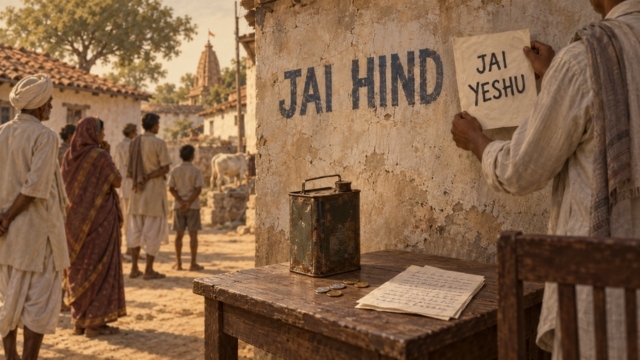
A written statement said that missionaries objected to “Jai Hind” painted on a wall and wanted it replaced with “Jai Yeshu.” It also claimed that some people received kerosene and a small monthly payment and were expected to greet others with “Jai Yeshu” instead of “Ram Ram.” Some people began using “Jai Yeshu” as a greeting.
It was stated that why would people desire Portuguese to leave Goa after ruling it for 400 years. It was believed that people were content. After conversion the dressing style changed and people acquired the air of a foreigner resulting in the contempt for the fellow countrymen.
Missionaries many times alleged Christians were harassed by government officials and their schools had to face discrimination, but it became clear that the reason actually was that some schools did not get government recognition.
Obviously some conditions were imposed for the recognition as the schools were used as effective tools for conversion. So the government had to be careful about it. The missionary schools did not wish to follow the rules and regulations seriously. The registers were not maintained, the institutions hesitated to disclose the full information of students.
Teachers acted as pracharaks, were untrained and paid for preaching mainly.The syllabus of the state was not followed. Non-Christians had to face difficulties, the mission people were aware of all the irregularities. In the absence of complaints mainly recognition was given by the state.
The churches also had a sort of competition to bring the people under their church from the existing church. This is also noted by the commission
Written by
Professor Vidya Deshpande